LLM Providers
An LLM Provider holds the connection credentials for a Large Language Model API. Providers are scoped per
tenant, and you need at least one before any agent can run. The zango-app-developer plugin
creates and configures providers for you through the platform API, so this page is a reference for what a
provider is and what it stores, not a click-by-click guide.
Tell the plugin "use Anthropic Claude for this app" and it creates the provider, stores the key encrypted, and selects a default model through the platform API. The same settings are available to adjust by hand in the App Panel if you ever need to.
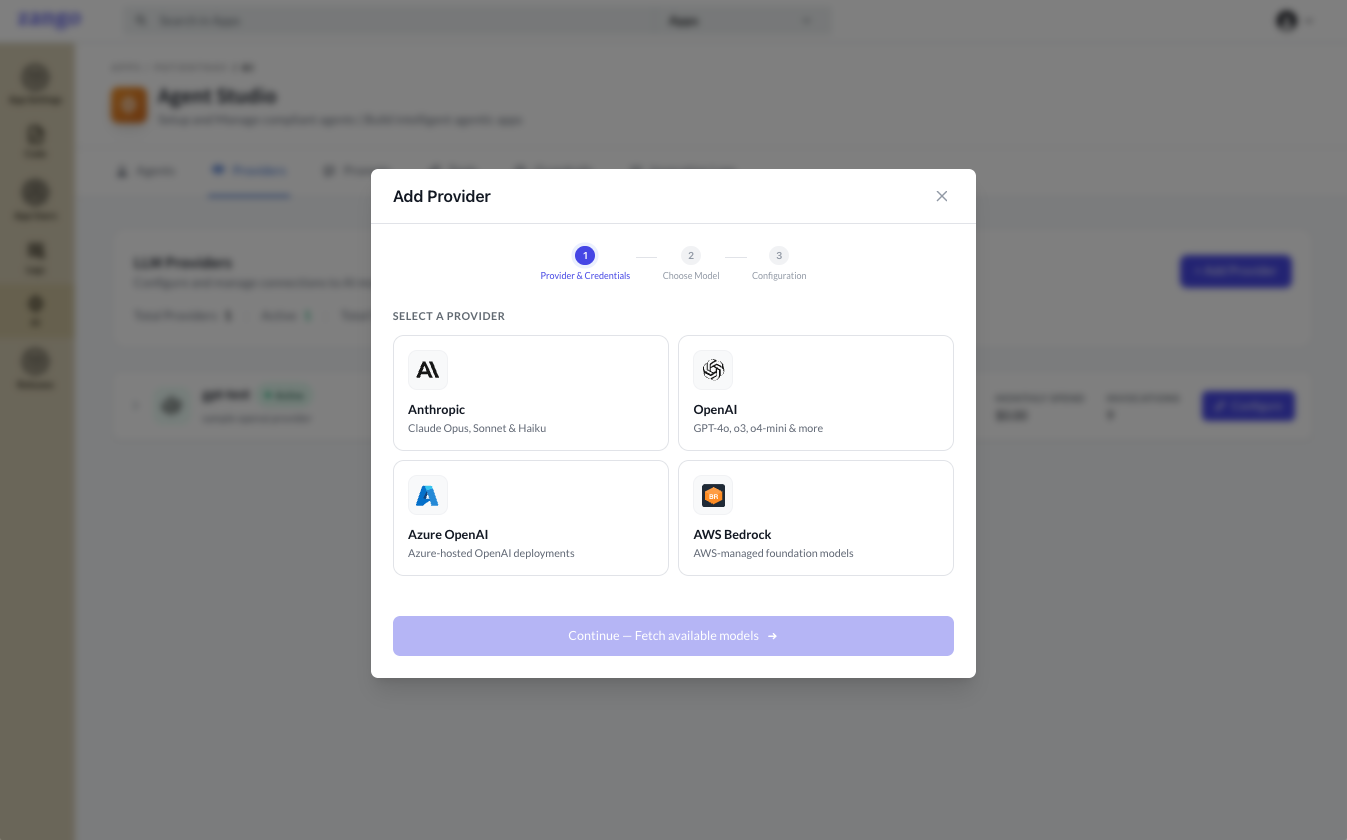
Supported providers
Zango currently supports OpenAI and Anthropic. Available models are fetched automatically from the provider once a valid API key is saved. Azure OpenAI and Amazon Bedrock are planned.
What a provider stores
| Field | Description |
|---|---|
| Provider Type | OpenAI, Anthropic, or custom |
| API Key | Stored encrypted with field-level encryption; never exposed in plaintext after saving |
| Organization ID | OpenAI only; optional organization identifier |
| Model | The default model selected from the provider's available list |
| Rate Limit | Maximum requests per minute; blank for no limit |
| Monthly Budget (USD) | Spend cap; Zango stops routing requests once it is reached |
Security
API keys are encrypted at rest using Zango's FIELD_ENCRYPTION_KEY. The key value is
write-only: once saved, only its name is visible, and you can rotate it at any time.
Never put LLM API keys in your app code or the project .env file. Provider credentials live
encrypted per tenant and are not shared across apps. This is the same Secrets mechanism the rest of the
platform uses.
Multiple providers
You can configure multiple providers per tenant, and each agent selects its provider individually. That lets you mix providers across agents in the same tenant, for example a fast, cheap model for classification and a frontier model for synthesis.
Next steps
With a provider in place, create an agent and select it.